
Properties That Shed Water Instead of Holding It
Drainage Solutions in Jacksonville for foundation cracks, landscape erosion, and standing water that won't clear after storms
Standing water around your foundation doesn't just create mud—it applies hydrostatic pressure against basement walls, undermines footing stability, and creates conditions for mold growth inside crawlspaces. Patriot Property and Lawn Services LLC develops drainage solutions that redirect water away from structures before it penetrates, based on how your property's grading and soil composition move stormwater during heavy rain. Homeowners in Jacksonville see this frequently after coastal weather patterns drop several inches in short periods, overwhelming shallow soils that already drain slowly.
Poor drainage contributes to foundation settling, driveway washout, landscape plant death from root saturation, and exterior wall staining from constant moisture exposure. Customized drainage plans account for where water enters your property, where it currently pools, and where it can be discharged without creating problems for adjacent areas or violating stormwater codes.
Schedule a drainage consultation to map water movement patterns across your property before erosion reaches structural elements.
Why Drainage Problems Require Site-Specific Engineering
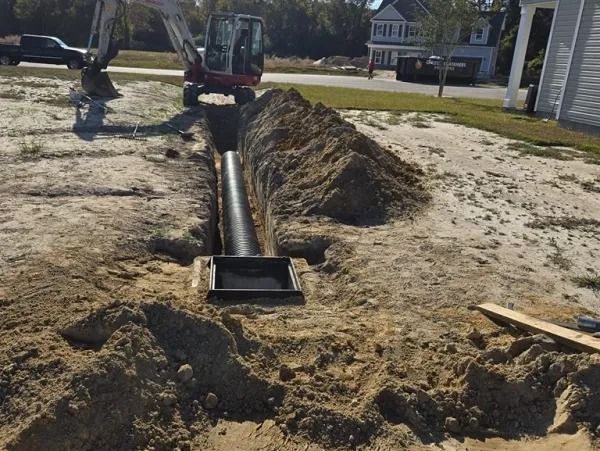
Effective drainage design starts with understanding your property's elevation changes, soil percolation rates, and existing water sources—roof runoff, groundwater seepage, and surface flow from higher elevations all require different interception methods. French drains address subsurface water that saturates soil below grade, roof runoff systems control concentrated discharge from gutters, drywells provide underground storage for excess stormwater, and storm drainage channels move surface water along defined paths.
Once the system installs correctly, you'll notice water clears from problem areas within hours instead of days, foundation perimeters stay dry even during extended rain, and landscaping survives wet seasons without root rot or erosion channels cutting through planting beds. Driveways stop developing potholes where water previously pooled and froze, and crawlspace humidity drops because exterior water no longer saturates the soil directly beneath your home.
Solving drainage at the source means identifying where water originates and intercepting it before it reaches vulnerable areas—surface treatments like regrading or adding stone don't work when the problem comes from subsurface seepage or concentrated roof discharge that overwhelms soil absorption capacity.
Questions Property Owners Have About Drainage Systems
Drainage failures in coastal North Carolina stem from flat topography, clay-heavy soils, and high water tables that limit where water can be redirected. Effective solutions account for these regional constraints while addressing the specific patterns water follows on your property.
What causes drainage problems to develop on properties that previously shed water fine?
Soil compaction from vehicle traffic or construction equipment reduces percolation rates over time, gutter systems that discharge directly onto grade create concentrated flows that exceed soil absorption capacity, and landscape maturation changes how roots and canopy cover affect water infiltration—what worked for bare soil during construction often fails once the property fully develops.
How does poor drainage damage foundations beyond visible cracks?
Constant moisture against foundation walls increases hydrostatic pressure that forces water through porous concrete, creates conditions for freeze-thaw cycles that widen existing cracks, and saturates the soil under footings enough to reduce bearing capacity and cause differential settling across the structure.
When should I install drainage systems instead of just regrading the yard?
Install drainage when water comes from subsurface seepage that regrading won't intercept, when your property sits lower than surrounding areas and receives runoff you can't block at the source, or when roof discharge volumes exceed what soil can absorb even with proper grading—regrading moves surface water but doesn't address water that enters below grade or arrives faster than soil percolation rates allow.
What determines whether I need French drains versus surface storm drains?
French drains capture subsurface water that saturates soil below the surface, while storm drains move water that flows across the surface—properties with high water tables or seepage from uphill sources need subsurface interception, while properties with poor grading or concentrated roof discharge need surface channel systems.
How do drainage solutions integrate with existing landscaping and hardscaping?
Systems are routed to follow property lines, run beneath driveways using sleeved pipe, and discharge into areas where additional water supports rather than harms existing plants—installation avoids removing mature landscaping whenever subsurface routing or strategic grading provides access to interception points.
Patriot Property and Lawn Services LLC maps your property's water movement during actual rain events to identify where intervention provides the most protection. Request a site evaluation to document current drainage patterns and review solution options specific to your topography.