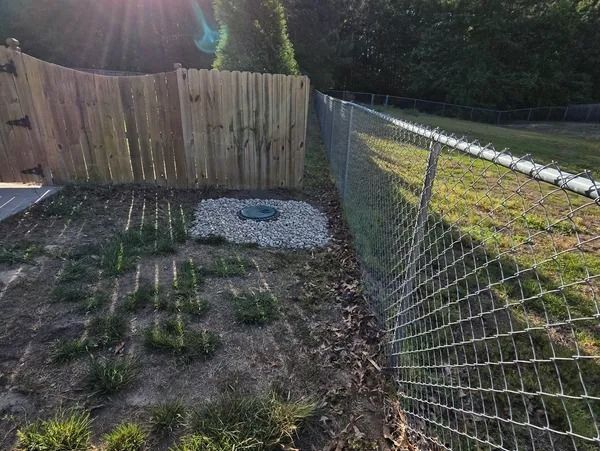

Underground Storage That Handles Stormwater Peaks
Drywells in Jacksonville for properties with limited discharge options, standing water during heavy storms, and runoff that can't drain to lower elevations
Properties without downslope discharge options still need somewhere for stormwater to go when soil absorption can't keep pace with rainfall rates. A drywell creates an underground reservoir where water collects temporarily and then disperses slowly into surrounding soil layers that remain unsaturated below the surface. Patriot Property and Lawn Services LLC installs these systems where roof runoff, French drain discharge, or surface storm drainage needs a terminus point that won't create surface ponding or route water back toward structures. You need this solution when your property sits in a low area surrounded by higher elevations, when local regulations restrict surface discharge, or when soil percolation rates are adequate at depth, but surface layers remain saturated during extended rain.
The installation involves excavating a large chamber below the frost line, filling it with clean stone or installing manufactured storage modules, and connecting incoming drainage pipes at elevations that allow gravity flow. Water entering the drywell disperses through the stone into surrounding soil over hours or days, depending on native percolation rates and water table depth.
Request a project estimate to determine drywell sizing based on your property's drainage volume and soil infiltration capacity.
What Drywells Actually Accomplish
Drywells function as temporary storage that buffers peak inflow rates—during intense storms, water enters faster than surrounding soil absorbs it, so the chamber holds excess volume until rainfall slows and infiltration catches up. This prevents backup in connected drainage pipes and eliminates surface flooding in areas where the drywell receives discharge from multiple sources like roof runoff and French drains combined.
After installation completes and the system handles its first significant storm, you'll notice that areas previously submerged during heavy rain now stay at or near grade surface, connected drainage pipes no longer back up with water during peak rainfall, and your property becomes usable hours sooner after storms end because temporary storage allowed infiltration to occur gradually rather than overwhelming surface soil layers. The drywell remains invisible at the surface while providing capacity that prevents your drainage infrastructure from exceeding design limits during extreme weather.
Drywell effectiveness depends on adequate sizing for the volume it receives, placement in soil with sufficient percolation capacity at depth, and location above the seasonal high water table—undersized drywells fill completely and stop accepting inflow during large storms, while those placed in impermeable clay or below the water table never drain and provide no storage benefit.
What Property Owners Need to Know About Drywells
Eastern North Carolina's flat terrain and clay-heavy soils limit where drywells function effectively, making proper site evaluation critical before installation. Systems must be located where soil conditions at depth support infiltration rates that empty the chamber between storm events.
What determines drywell size for my property's needs?
Sizing depends on total drainage volume from connected sources—roof area, French drain length, and storm drainage runoff—plus local rainfall intensity and soil infiltration rate, with the goal of providing enough temporary storage that the chamber doesn't fill completely during design storm events typical for the region.
How deep do drywells need to be installed to function correctly?
Drywells must be placed above the seasonal high water table so surrounding soil provides unsaturated infiltration capacity, typically requiring excavation to at least four feet in most residential applications but deeper in areas with high water tables or where incoming drainage pipes require burial below frost depth.
When do drywells require overflow connections to prevent system backup?
Overflow provisions are necessary when soil infiltration rates can't keep pace with extreme storm volumes, when the water table seasonally rises close to drywell depth, or when local regulations require secondary discharge paths—overflows typically connect to storm sewers, surface swales, or lower-elevation discharge points that activate only when the drywell reaches capacity.
What causes drywells to lose infiltration capacity over time?
Silt accumulation on stone surfaces reduces permeability as fine particles fill voids between aggregate, organic debris creates biological films that block water movement, or surrounding soil becomes compacted from repeated saturation cycles—proper filtration at inlet points and periodic inspection prevent most capacity loss.
How do drywells integrate with existing drainage systems already on the property?
Drywells serve as collection points where multiple drainage sources discharge—roof runoff pipes, French drain outlets, and surface storm drains can all terminate at a single drywell sized to handle combined volumes, eliminating the need for separate discharge locations and reducing total excavation across the property.
Patriot Property and Lawn Services LLC performs soil percolation testing at proposed drywell locations to confirm infiltration rates support the temporary storage approach before excavation begins. Schedule a consultation to evaluate whether your property's soil conditions and water table depth make drywells a viable solution for your drainage needs.